
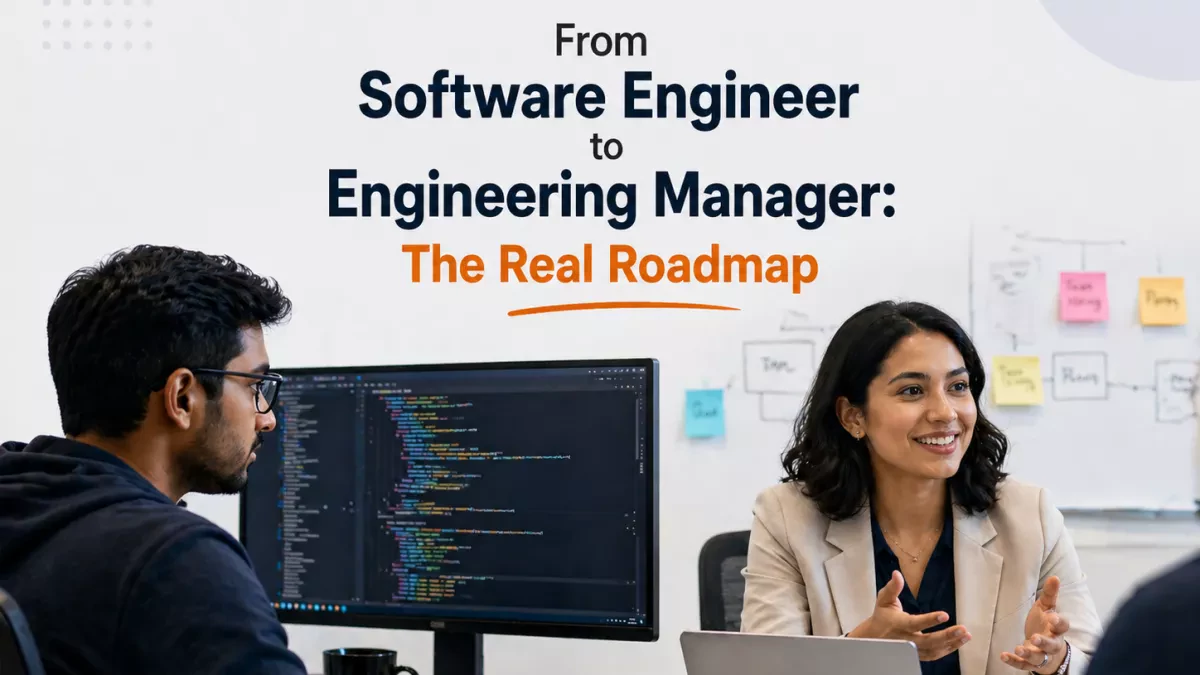
The jump from senior engineer to engineering manager is one of the most misunderstood transitions in tech. People assume it is a promotion, a step up, a natural reward for doing strong technical work for several years. In reality it is a complete change of job. The skills that made you a strong individual contributor will help you a little, but most of what makes a great manager has very little to do with code.
If you are thinking about making this move in 2026, the path looks different than it did even three or four years ago. AI has changed how teams work. Layoffs and restructurings have changed how companies think about middle management. And the bar for new managers has gotten higher in many places, not lower.
Here is what the real road from senior IC to engineering manager looks like, based on patterns from people who have made the move recently and people who help others do it well.
Many engineers chase the manager title because it feels like the only way forward. That is rarely true anymore. Most strong tech companies now have parallel IC tracks that go all the way up to staff, principal, and even distinguished levels. The pay can match or exceed manager roles, especially in deep technical areas like systems, infrastructure, and machine learning.
So before you start angling for the manager seat, ask yourself a different question. Do you actually like the work managers do? That work is mostly people work. One on ones every week with five to nine engineers. Career conversations. Performance reviews. Hiring loops. Cross team alignment meetings. Conflict resolution. Tracking project progress and explaining delays to leadership. Reading between the lines on what your team is feeling.
If those tasks excite you, you are in the right zone. If they feel draining and you would rather be deep in code, the IC path will likely serve you far better. Spending an hour with someone who has been through both can save you years of frustration. This is exactly the kind of decision a conversation with experienced mentors helps clarify quickly, because they have seen the pattern many times.
The biggest mistake aspiring managers make is waiting until they get the role to start acting like a manager. By then it is too late. Companies promote people who already look like managers. They almost never give the title and then hope the person grows into it from scratch.
Here is what you should be doing as a senior IC who wants the role next.
Mentor a junior engineer formally. Not a casual chat. A real weekly check in where you help them grow, set goals, and work through challenges. Document what works and what does not. This is the foundation of management, in miniature.
Run a project end to end. Take ownership of something that involves multiple people, scope it, break it down, track it, and deliver it. Learn how to ask for status updates without sounding like you are micromanaging. Learn how to escalate without burning bridges with peers.
Speak up in cross team meetings. Managers spend a huge amount of time representing their team to others. Practice doing this even before you have a team to represent.
Get involved in hiring. Volunteer to interview candidates. Help screen resumes. Sit in on debrief discussions. The more you understand about how hiring decisions get made, the more credible you become as a future manager who will lead those decisions.
This is the part where many engineers benefit from working through the transition from IC to manager with someone who has done it themselves. The patterns are real, the pitfalls are predictable, and avoiding them on your own is genuinely hard.
Once you are clearly performing as a manager would, the question becomes how to actually get the title. There are usually two paths to consider.
The first is internal. Your current manager moves on or grows their org, and you step up. This works when you have been visible, when leadership trusts you, and when you have built a track record of judgment. It often takes one to two years of intentional positioning, and timing matters as much as performance.
The second is external. You apply to a manager role at a different company. This is faster but harder. You will face interviews that test people skills, scenarios, and leadership thinking. The behavioral round will be heavier than anything you faced as an IC. Practicing this with someone experienced is almost always worth it. A round of behavioral interview practice can change the outcome of a hiring loop entirely. Same with mock interviews that simulate the kind of management scenarios hiring committees actually use to evaluate candidates.
Getting the role is not the hardest part. The hardest part is the first year as a new manager.
The first three months are disorienting for almost everyone. You will feel like you are not doing real work. Your old engineering instincts will pull you toward writing code or jumping into design discussions. Resist this pull, mostly. Your job is to make your team effective, not to be the smartest person in the room.
You will also discover that management has its own learning curve, and the curve is steep. Things that look obvious from the outside, like running a productive one on one or giving difficult feedback, are genuinely hard to do well. Most new managers underestimate just how much they have to learn about people.
This is the period when many new managers stumble. Some recover quickly. Some quietly fail and either go back to IC or get pushed out a year later. The difference is usually whether the person had a sounding board outside their own management chain to talk things through honestly.
A trusted advisor or coach during your first year as a manager is genuinely one of the best investments you can make. Not just for performance reasons. For sanity reasons. The job can feel isolating, and your boss is not always the right person to be honest with about your struggles.
After the first year, the curve flattens and the work starts feeling natural. You begin developing a style. You learn which battles to pick and which to let go. You start seeing your team grow under your guidance, and that becomes the most rewarding part of the work.
This is also the moment to start thinking about what comes next. Senior engineering manager roles open up to people who have run a team of five to ten engineers well for two or three years. Building and scaling teams becomes a different kind of skill, and it is one that compounds quickly. Working through building and scaling teams with someone who has done it before is how many strong managers reach the next level faster than their peers.
For those further along, the path opens up to senior engineering manager, then director, then VP. Each level requires letting go of more day to day work and getting better at strategy, influence, and organizational design.
The manager track is not for everyone, and even for those who choose it, it is not a straight line. People go back to IC roles. People take breaks. People discover after two years that they prefer the technical depth of a staff engineer role and switch back. None of this is failure. It is just self knowledge arriving on a delayed schedule.
What matters is making the choice with eyes open, then committing fully once you have made it. The role is genuinely interesting when it fits, and genuinely painful when it does not.
If you have spent your whole career building things and now spend most of your days listening to people, that is a real shift. Some people fall in love with it. Some people grieve the work they used to do. Both reactions are normal.
Resources, mentors, and frameworks are available across websites like betopten.com for engineers who want to navigate this transition with more clarity than they would get on their own. The road is real, but it is walkable when you know where the turns are. The engineers who handle this transition well are not the ones who got lucky. They are the ones who took it seriously, prepared early, and asked for help when the work got hard.