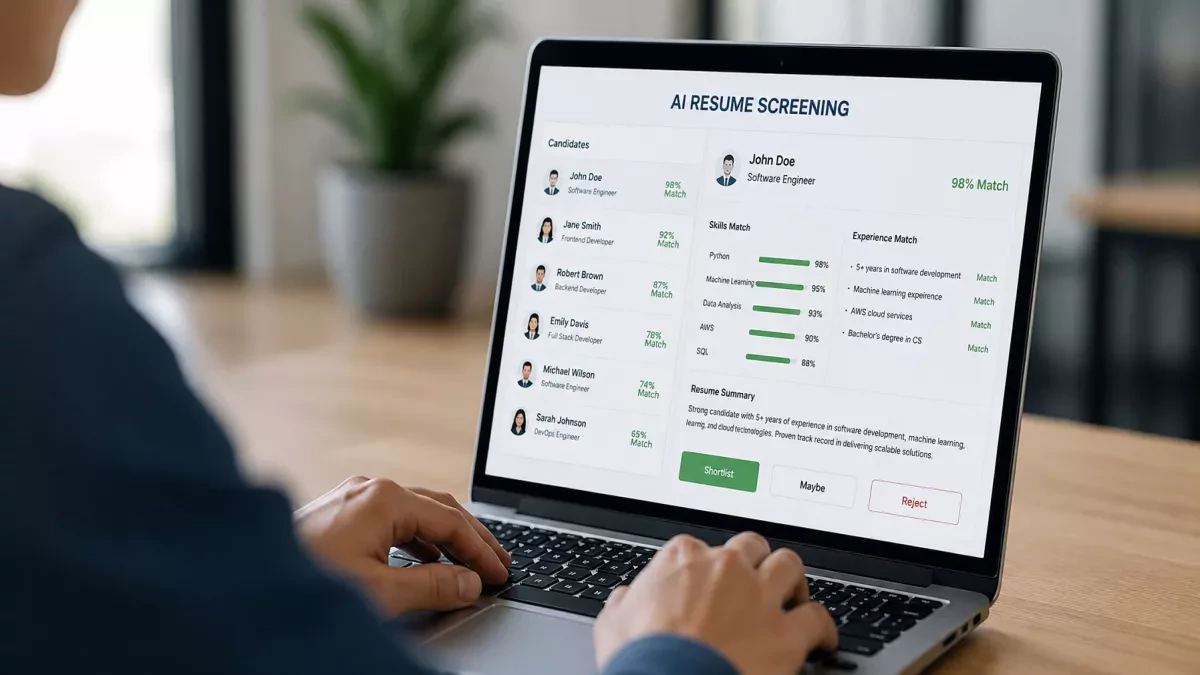
The hiring world has changed more in the last two years than in the previous decade. If you submitted a resume in 2022, it likely passed through a basic Applicant Tracking System that scanned for keyword matches. Submit that same resume today, and a large language model is reading it like a recruiter would, picking up on context, tone, narrative, and even the implied story behind your career moves.
Most candidates have not caught up. They are still optimizing for the old game while the rules have quietly shifted. If you are wondering why your applications keep disappearing into the void despite what looks like a strong profile, the answer often lies in how AI screeners have evolved and what they now reward.
The old ATS played a simple game. It looked for exact phrase matches between your resume and the job description. If the role required Python and your resume said Python in the right places, you scored higher. Stuff your resume with the right words, even invisibly in white text, and you could climb the rankings.
That trick stopped working around 2024. Modern hiring platforms now run candidate resumes through fine tuned language models that understand semantic meaning. They know that "built distributed systems handling 10 million requests per day" implies backend expertise, scalability skills, and probably some database tuning, even if the words "scalability" and "database optimization" never appear on your resume.
These models also flag inconsistencies. If your job titles do not match your described responsibilities, or if your career timeline has unexplained gaps, the system notices. Some platforms now generate a short summary of each candidate for the recruiter, essentially writing a one paragraph review of your career before a human ever opens the file.
There are five things modern screeners pay attention to, and only one of them is keywords.
The first is impact density. The model reads each bullet point and tries to extract a measurable outcome. Vague bullets like "responsible for backend services" score poorly. Specific ones like "reduced API latency by 40 percent across three core services serving 2 million daily active users" score highly because they contain action, scope, and result.
The second is role progression. Screeners check whether your career shows growth or stagnation. Lateral moves are fine if explained well, but a flat trajectory across many years without expanded scope or responsibility raises questions. This is one reason senior candidates pause and reframe their experience as a narrative of growth rather than a list of jobs.
The third is contextual relevance. The model compares your resume against the job description holistically. A candidate with adjacent but transferable experience often beats one with exact keyword matches but weaker overall context. This is good news if you are pivoting, and it explains why thoughtful framing matters more than ever.
The fourth is signal density per line. Modern screeners are trained on thousands of strong and weak resumes. They have learned that filler phrases like "team player" and "results driven" actively lower a candidate's score. Every line either earns its place or hurts you.
The fifth is integrity checks. Many systems now cross reference your resume with public profiles like LinkedIn and GitHub. Mismatched dates, inflated titles, or claimed contributions that do not show up in your public footprint can quietly kill an application.
The good news is that what works on AI screeners in 2026 also works on human reviewers. Optimization for one improves the other.
Start with outcome focused bullets. Every bullet should answer three questions in one line: what did you do, how did you do it, and what was the measurable result. If you cannot quantify the impact, at least describe the scale of the system or team you worked with.
Use natural language that mirrors how senior engineers and managers actually talk about their work. AI models trained on real workplace text recognize authentic technical writing. Phrases that sound like marketing copy stand out as artificial. Write the way you would describe your work in a coffee chat with a peer.
Match the language register of your target roles. If you are applying for staff engineer positions, your resume should read like a staff engineer wrote it, with concerns about cross team alignment, technical strategy, and influence. If you are applying for senior roles after a stint in management, working through a thoughtful manager to IC transition plan helps you reframe your experience accurately rather than hiding it.
Keep formatting clean and machine readable. Avoid tables, columns, headers embedded in graphics, and unusual fonts. PDF is still the safest format. Save as plain text and read it back. If it is hard to follow as plain text, the screener will struggle too.
Drop the keyword stuffing. Modern screeners actively penalize density that feels unnatural. Use the right terminology where it fits the story, not as a checklist item.
This is the part most candidates miss in 2026. Recruiters increasingly use AI tools that pull your public profiles into the screening picture. If your resume claims you led a major migration but your GitHub shows mostly small fixes from that period, the system flags the gap. If your LinkedIn has different dates or titles than your resume, the discrepancy gets surfaced before a human ever sees you.
Audit your public footprint before applying. Make sure your LinkedIn matches your resume word for word on dates and titles, and consider getting a portfolio and GitHub review if your repositories do not visibly support the impact you claim. A clean, well organized GitHub with thoughtful commits and meaningful project READMEs adds significant weight to your application.
Similarly, a LinkedIn optimization pass ensures your headline, about section, and experience descriptions reinforce the same narrative as your resume. Consistency across surfaces is now a ranked signal in many screening systems, not a nice to have.
Despite all the screening sophistication, one thing has not changed. A warm referral skips most of this entirely. When a current employee recommends you, your resume goes into a different pile, often reviewed by a human first. This is why building a thoughtful referral and networking strategy consistently outperforms cold applications, regardless of how AI proof your resume is.
Mentorship from someone who hires for the role you want is another underused edge. Working with experienced mentors from the companies you are targeting gives you direct feedback on whether your resume reflects the seniority and impact you claim. They have read thousands of resumes and can tell you within minutes what is working and what is not.
For those preparing seriously, combining a polished resume with a few rounds of mock interviews closes the loop. A strong resume gets you in the room. A confident, well prepared interview gets you the offer.
Some candidates ask whether they should use AI tools to write their resumes. The honest answer is yes, but carefully. AI generated bullets often sound generic and trigger the same red flags that strong screeners are trained to catch. Use AI as a starting point, then heavily edit toward your real voice and your specific impact.
The candidates who win in 2026 are not the ones with the most clever ATS hacks. They are the ones who treat their resume as a clear, honest, evidence rich document of their actual work, then back it up with a public footprint and a network that confirms the story. The AI screener is just the first reader. Write for the human at the end of the line, and the machine will let you through. For deeper guidance on positioning yourself for senior roles, platforms like BeTopTen connect you with leaders from FAANG and top product companies who know exactly what these systems look for.